
How to Install Cheap LED Pod Lights (All Vehicles)
Author
Logan Kuzyk
Date Published

Adding LED light pods is a practical and budget-friendly upgrade for off-roading. Premium brands like KC or Baja Designs make some great products, they are usually hundreds of dollars and way too nice for a vehicle like my 1997 Nissan Pathfinder. For this project, I installed a set of $30 light pods from eBay to see if lights like these are worth it at all.
In this guide, I'll walk you through choosing and installing budget LED lights. Everything from tips on placement to a wiring diagram.
I initially created this guide as a video, which is available here: https://youtu.be/snbEFXviaNI
Components Required
Here’s a list of the necessary parts to install two light pods. Depending on how you mount them, additional hardware might be needed, but most light pods come with basic mounting brackets which should be enough to at least mount them on a flat surface.
- Two light pods https://amzn.to/3ZCMMgu
- 16-gauge wire (10–20 feet)
- Fuse holder with a 10-amp fuse
- Spade connectors
- Butt connectors
- Ring connectors
- 3 or 5-pin switch
- Heat shrink tubing
- Dielectric grease
If you use these links to purchase any products, I will receive a commission which helps me run this website and continue creating articles and videos. Thanks for your support!
Ensure you know the wattage of your lights, as this determines the appropriate wire gauge and fuse size. While this list is general, it should work for most dual LED pod setups.
Step 1: Choosing a Location
The first step is deciding where to place the lights. Light pods are versatile and can be mounted in various locations, here are some common places:
- A-pillar brackets on the hood (usually requires drilling)
- Roof racks (better for higher-end lights with focused beams)
- Rear bumper (for a reverse light)
- Front bumper (cleanest option in my opinion)
I opted to mount the lights next to the license plate on the Pathfinder's front bumper. This is where the factory fog lights were placed in higher-spec models of my vehicle. It's a tidy place to put them, and doesn't look too extreme.
Step 2: Wiring the Circuit
To connect the light pods to your vehicle's electrical system, you need to create a circuit connected to the battery. The main challenge in this step is to get the power wire through the firewall, which is what separates the engine bay from the passenger compartment. If you're hooking up both lights to one switch like I did, you're going to want to have the lights connected in parallel.
For this setup, I used a 5-pin switch, though a 3-pin switch would work as well. The 5-pin switch includes additional pins for backlighting, which I didn’t connect.
Here's my hand-drawn wiring diagram which shows how I connected everything:
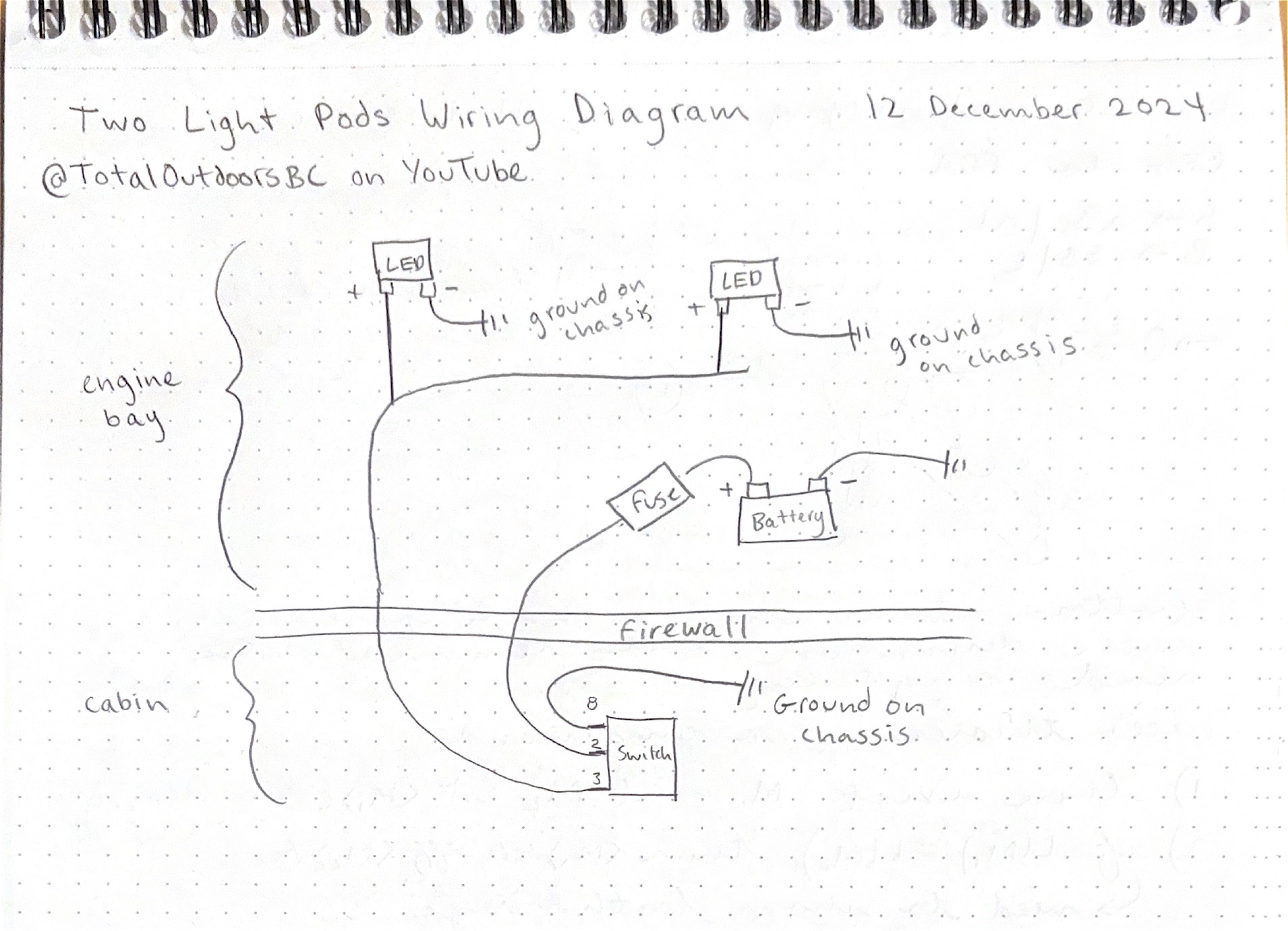
Wiring diagram showing how I installed two light pods controlled by a single switch.
Wiring Diagram Overview
The basic circuit involves:
- Power from the battery to the switch
- Power from the switch to the lights
- Ground connections for both the switch and lights
If you are planning on installing more lights in the future, I would recommend considering a switch panel. A switch panel makes adding new lights a lot easier by reducing the amount of wiring to do.
Step 3: Installation
I began by removing the centre portion of the dashboard to install the switch in one of the blank slots at the bottom of the centre piece of the dashboard. Your vehicle might not have removable blank switch plugs. If it doesn't have any blank switches, you could find somewhere else on the dashboard to drill and mount the switch. If the blank switch spots aren't removable, you can try drilling and grinding them to make way for the switch. Just make sure you're going to be able to access the backside of the switch somehow.
Routing wires from the cabin to the engine bay was the hardest part for me. In my manual vehicle, the clutch cylinder limited space, so I used the wiring harness grommet above the throttle pedal. If you have an automatic Nissan Pathfinder (R50), the clutch delete plate would be the best spot to route the wires through. Some brands like Toyota actually provide blank grommets for this exact purpose, just use whatever is easiest. Now for connecting the rest of the components:
1. Attach the switch: Secure the ground wire to a chassis stud and connect the power wires to the switch using labeled spade connectors.
2. Run power and ground wires: Route wires from the battery and to the lights. Use heat shrink tubing to seal connections.
3. Install the lights: Bolt the lights in place, if you have cheap lights I recommend pointing them straight out. Ground the lights to the chassis using a ring connector.
4. Add a fuse holder: Install the fuse holder at the end of the wire to be connected to the battery and double check everything before plugging in the fuse.
Results
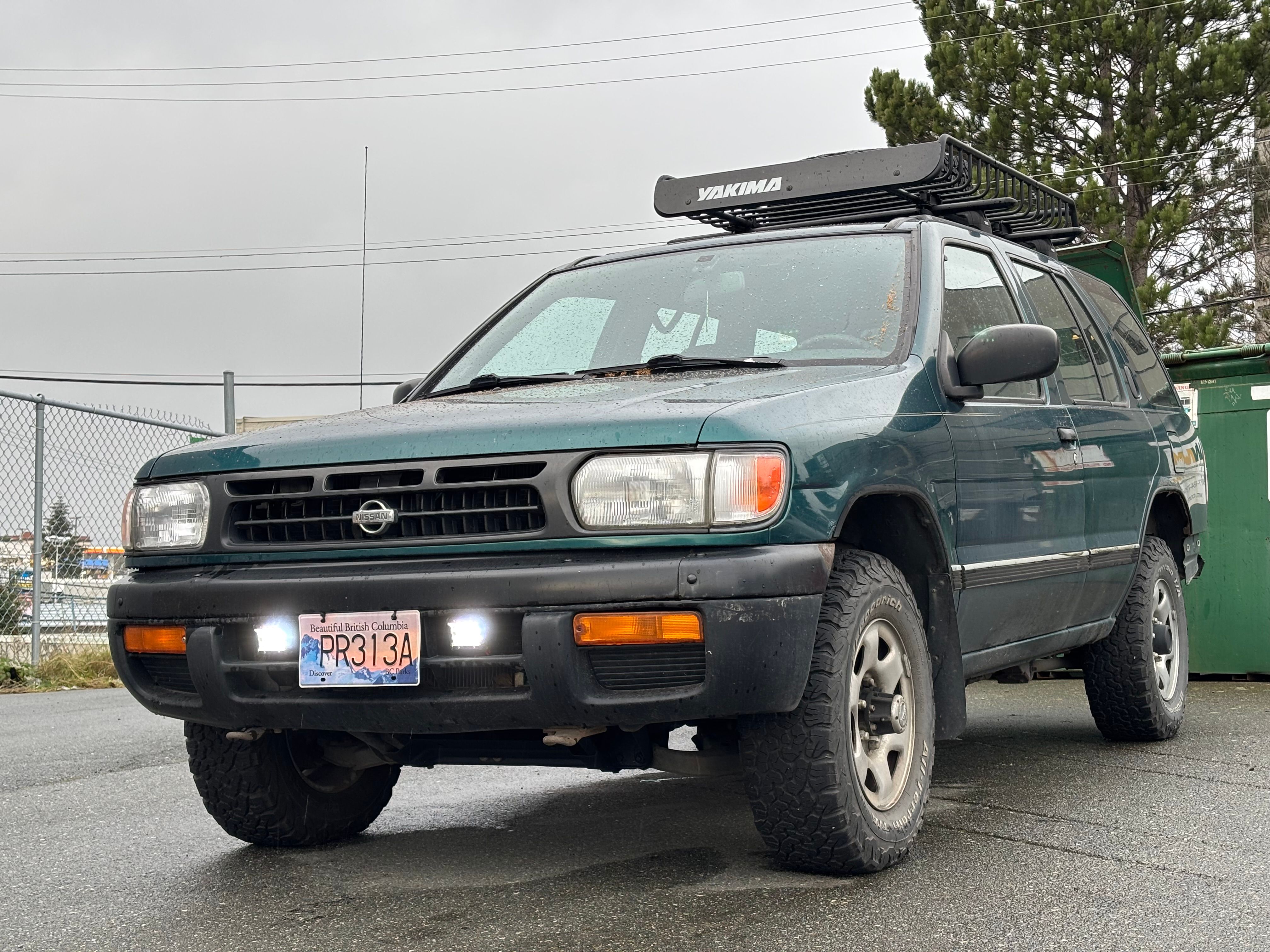
My Pathfinder with the two light pods on.
Overall, I'm pretty happy with the lights and I definitely think they're worth the price. So far, I've had them installed on my vehicle for a whole year and I haven't had any issues with them since I got them working. If I had to do it all again, I would probably get slightly nicer lights, maybe in the $100-150 price range and I would use bullet connectors instead of crimps.
Check out my video to see them in action!
Final Thoughts
Installing LED light pods like these is probably one of the cheapest upgrades you can make for off-roading. It's a great way to boost your visibility on dark trails while gaining some skills with installing electrical components. Nicer lights definitely have their place, and cheap ones do as well. Just make sure you don't use them on public roads.